Imagine two plant-based patties with the same amount of protein and the same flavoring. One seems dry and springy; the other feels softer and releases its flavor differently. Nothing in the protein number alone explains the difference. The missing information is the arrangement of the food: what holds it together, what happens to its water and fat, and how that structure changes while someone eats it.
The scenario is hypothetical, but a 2026 study in Applied Food Research provides a closely related observation. Researchers varied ingredients in vegan patties while keeping the flavor type and concentration the same. Texture differences were prominent, and smaller significant differences in flavor perception appeared too. Methylcellulose content and the type of textured protein had particularly important effects in those formulations.
That finding does not identify a perfect supermarket burger. It shows why “more protein” is an incomplete development brief. A food is a structure encountered over time, not merely a list of substances. The space and relationships between the proteins can be central to what the eater notices.
There is a commercial implication as well. Companies may describe ingredients through purity and origin because those are convenient specifications. Customers experience the finished food. Connecting the two requires knowing what the ingredient does in the mixture, rather than assuming its nutritional percentage predicts its culinary behavior.
First, remove the label
“Plant-based” groups together foods that perform very different jobs. A drink should pour; a patty should hold together; a whipped topping needs to retain air; a sauce may need to keep oil dispersed. These are not interchangeable tests. The same ingredient can be useful in one application and frustrating in another.
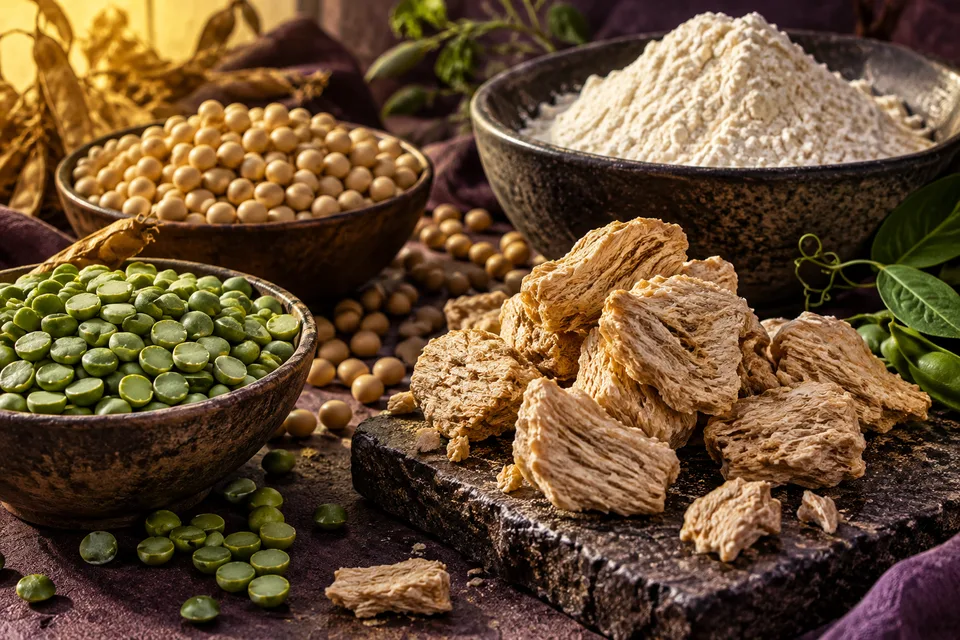
Even a single crop supplies different possible ingredients. A whole pea, a flour, a protein-enriched fraction and a more purified isolate have different compositions and processing histories. Calling each “pea protein” can obscure the distinctions that matter in formulation. The buyer needs to know which material is being offered and what it is expected to do.
Remco Kornet’s 2021 Wageningen doctoral research examined how fractionation affected pea-protein behavior. In one comparison at neutral pH, membrane-filtered fractions produced more homogeneous, stiffer emulsion-filled gels than isoelectrically precipitated fractions. At pH 5 their rheological behavior became much more similar. The extraction method mattered, but so did the environment into which the ingredient went. That is a concrete reason a powder that works in one recipe may behave differently in another, even before its protein percentage changes.
For a product developer, this suggests a more useful opening question than which crop is fashionable. What function is needed, and which fraction or process provides it under the food’s actual conditions? A foam and a firm gel might require different choices even when both start from the same seed.
It also explains why replacing one supplier’s powder with another can be more involved than matching protein percentages. The composition, state and processing of the material are part of its behavior. An ingredient specification needs to connect with application testing, not simply provide a reassuring number for the nutrition panel.
Now follow the water
Water can be present without being released in the way an eater associates with juiciness. A food that retains liquid very strongly may behave differently from one that releases it during chewing. Conversely, liquid lost during preparation does not contribute to the experience of the final bite. The timing of movement matters.
A November 2025 Wageningen thesis investigates the effects of textured vegetable protein, oil and binding agents on mechanical properties, lubrication and the release of water and oil during consumption. Its focus is a useful corrective to treating juiciness as a moisture-content measurement. The product’s mechanics help determine what happens to its liquids.
Our imaginary patty therefore needs a description of more than the water poured into the mixing bowl. It needs a structure capable of surviving preparation and producing the intended experience when eaten. Those objectives can pull in different directions: maintaining shape and releasing liquid are related design tasks, not synonyms.
This is one reason a binder can have a conspicuous sensory effect despite representing a smaller fraction of the recipe than the main protein ingredient. It participates in the structure holding the food together. Small compositional changes can therefore alter how the larger mass behaves.
The practical lesson is not to add or remove a particular substance in every product. It is to test the food as a system. A developer changing hydration, protein structure or binding needs to observe the combined result rather than assume each adjustment delivers an independent benefit. The formula is not a set of isolated sliders.
A flavor can be present and still arrive differently
Flavor perception is another journey through the structure. Substances have to reach the relevant sensory environment as the food is broken down. Two recipes with equal quantities of a flavoring can create different experiences if that process differs.
Rutger Brouwer’s December 2025 research examines this relationship in meat analogues. It distinguishes mechanisms affecting sodium and aroma release, and investigates the role of texture and juiciness. The work relates perception to the way the food changes during consumption rather than treating the flavor dose as a complete explanation.
This gives the apparently bland product a more interesting diagnosis. The answer may not be to keep adding seasoning. The structure might be affecting how an existing flavor is experienced. Additional flavoring could increase an ingredient bill while leaving the underlying release problem poorly understood.
It also limits what an instrument can tell us alone. Measuring composition is useful; measuring mechanical behavior is useful; asking people about a defined sensory experience is useful. Each provides a different part of the account. The combination can investigate a problem that none of the measurements resolves independently.
That does not make every disagreement between consumers a structural mystery. Preferences, expectations and the context of eating still differ. A product described as a familiar burger invites a different comparison from a vegetable dish presented on its own terms. Formulation and framing both help establish what the eater expects to encounter.
The fat has an architecture too
Oil is not simply a flavorless quantity added beside protein. How it is dispersed, retained and released can contribute to the texture and mouthfeel of the food. Looking at total fat alone misses that arrangement, just as total water misses its behavior.
One line of research considers oleosomes, the natural oil bodies found in seeds and other sources. A 2026 review in the Journal of Food Composition and Analysis describes their lipid cores and protective surface structures, along with extraction and application research. They offer an example of an ingredient arriving with an existing physical organization, rather than as separated oil to be arranged from scratch.
The interest lies in that organization. A manufacturer might investigate whether retaining or modifying a natural structure helps achieve an intended function. The answer depends on the source, process and application; the word natural does not establish that every recovered material works in every food.
There is a wider design idea here. Food production often separates raw materials into components and then recombines them. Sometimes that is useful or necessary. In other cases, a less separated ingredient may retain features worth using. The choice should follow the finished food’s requirements rather than a rule that more separation is always progress.
Our patty is therefore not merely protein plus a fat percentage. It is a relationship between materials. The relevant questions include where the fat sits, how it interacts with the surrounding structure and what happens during preparation and eating. Those questions can be investigated without pretending the answer is identical for every product.
Purity is a specification, not an ambition for every meal
There are sensible reasons to produce a concentrated ingredient. A manufacturer may need predictable composition, a particular function or limited amounts of other components. Purity can make some formulation decisions easier. It should not become an automatic ranking of food quality.
Wageningen’s food-process research program includes dry fractionation through milling and separation, as well as work on preserving useful properties in protein-enriched ingredients. It illustrates that an ingredient can be designed through different processing routes. The question is which route provides the needed material, with which resource use and performance.
A less refined fraction brings more than protein into the recipe. That can be helpful if those accompanying components serve the intended food, or inconvenient if they interfere with it. A more refined material may provide greater compositional control while requiring other ingredients to rebuild the desired structure. Neither description is a verdict until the application is specified.
This also makes sustainability claims more demanding. An assessment of processing should account for what useful products emerge, what happens to other fractions and how the ingredient performs in its final use. Saving one operation is valuable only within a credible account of the complete route. A food needing more material to achieve the same function presents a different comparison from one needing less.
The consumer does not need a technical dossier at dinner. But the people making and promoting the food should be able to explain why a particular process was chosen. “Highly purified” and “minimally processed” are both incomplete answers to a question about what the product does well.
Return the nutrition panel to its proper job
The argument about structure does not make composition unimportant. It simply prevents a texture result from becoming a nutrition result, or a protein percentage from becoming a taste forecast. These are different questions about the same food.
A product’s nutritional comparison should examine the actual finished formulation and a relevant serving. The amount of protein is one part of that information. Salt, fat and the other ingredients do not disappear because the protein came from a plant. Nor does a pleasant bite establish any particular health outcome.
The intended role of the food matters as well. Something sold as a main component of a meal invites a different assessment from an occasional snack or a condiment. A comparison should say what is being replaced and how the product is used, rather than promote a broad category as if every member had the same composition.
For shoppers, that argues for clear labels and useful product descriptions. For developers, it argues for keeping sensory goals, compositional goals and manufacturing goals visible together. A change made to solve one problem should be checked for its effects on the others. Better texture is worth pursuing without asking it to stand for every possible benefit.
What should the next brief ask for?
A useful development brief would describe an eating experience in a real application: a patty that remains coherent during preparation and releases liquid pleasantly, a sauce that holds its emulsion, or a topping that retains an appropriate foam. It would set relevant composition and production requirements beside that goal.
The trials would then compare materials under the intended conditions. They would record the ingredient’s process and composition, measure useful behavior and examine the finished food. If a promising material works only in a narrow model system, the next question is how it translates, not whether the first experiment has already established a market winner.
There is room for innovation in this less spectacular territory. Improving how an ingredient hydrates or how a mixture breaks down can matter greatly to the person eating it. The advance may have no convenient mascot and no dramatic new crop name. It may be an improved relationship between substances already present in the recipe.
Return to the two imaginary patties. Their matching protein numbers have become less mysterious because the question has changed. We are no longer asking why a nutritional label failed to predict a bite. We are asking how each food was put together, and what happened when that structure met a mouth.
Sources & context
This article draws on the sources linked in the text. Analysis and illustrative scenarios are identified separately from reported findings.
- 2026 study in Applied Food Research
- 2021 Wageningen doctoral research
- November 2025 Wageningen thesis
- December 2025 research
- 2026 review in the Journal of Food Composition and Analysis
- food-process research program