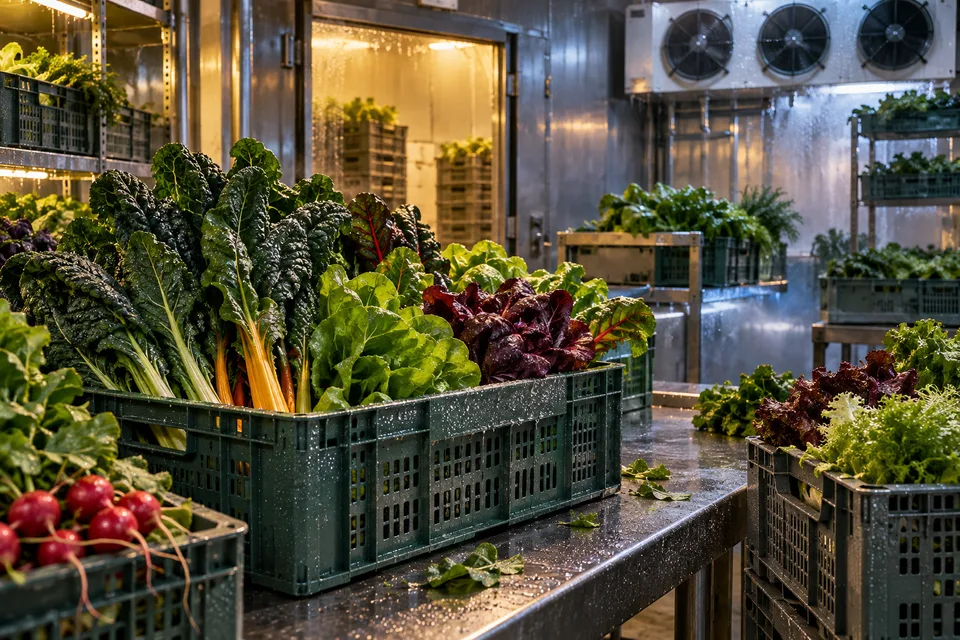
A tomato enters a cold room; a tomato leaves it. Between those moments lie choices about harvest condition, heat removal, storage and the next journey to market. The machine supplies one part of that service. Its usefulness depends on the crop arriving in time, the power staying on and a buyer being ready when the door opens again. Following those connections explains why a refrigeration project needs a food-system plan as much as a room that gets cold.
That journey begins before the door opens. Harvest timing, damage, containers and the interval before appropriate cooling all influence what enters. It continues after the door closes behind the departing crop, through transport, handling and the market. A refrigerated pause cannot reverse every problem acquired earlier or prevent every failure farther along.
UNEP and FAO’s 2022 Sustainable Food Cold Chains report makes a systems argument: cooling can reduce food loss, while refrigeration itself creates energy and refrigerant obligations. Its historical estimates should not be treated as fresh measurements of every current supply chain. The enduring point is the need to design food preservation and the impacts of cooling together.
Before the cold room: useful heat removal starts with the crop
Produce arrives with its own condition and temperature. A facility must be designed for the product, incoming load and intended operation. A room able to maintain already cooled goods is not automatically capable of removing heat quickly from a large new harvest. Storage capacity and cooling throughput are different capabilities.
The crop matters as much as the equipment. Tomatoes, leafy vegetables and other foods have different handling and temperature needs. A mixed room should not be treated as a universal preservation environment merely because all its contents were fresh when they arrived.
The University of California, Davis tomato fact sheet, last updated in 1997, makes the maturity distinction concrete:
| Tomato maturity | Listed optimum range | Scope or duration |
|---|---|---|
| Mature green | 12.5–15°C | Mature fruit before ripening |
| Light red | 10–12.5°C | USDA color stage 5 |
| Firm ripe | 7–10°C | Three to five days |
These longstanding commodity ranges illustrate why colder is not always better; they are not a commissioned facility design. The same guidance warns against storing ripening tomatoes with ethylene-sensitive lettuce and cucumbers. A room can offer a suitable thermometer reading and still be an unsuitable shared environment for its crop mixture.
Handling remains important. Bruising or other damage can compromise quality before the crop reaches the room. Suitable packaging and an orderly receiving process help the cooling service do the job it was installed to do. A facility can have an excellent compressor and still receive food already made harder to preserve.
This changes how a project should investigate loss. If the main problem occurs before arrival, adding more storage may treat the wrong stage. If the problem is an interval between harvest and transport, a service organized around that interval may be more useful. The first task is to locate the failure in the actual chain rather than assume the missing object must be a refrigerator.
Inside: the setpoint is not the whole condition
A displayed temperature is one piece of evidence. Airflow, loading, door use and the condition of the equipment influence what different products experience. A sensor in one location cannot automatically describe every container during every part of operation.
That is why commissioning and operating procedures matter. The system should be assessed under its intended use, including realistic loads and movement through the room. An empty-room demonstration is not equivalent to a busy harvest-period service. The comparison needs the conditions that define the promised performance.
UNEP and the International Institute of Refrigeration’s 2025 cold-chain technology briefs address walk-in cold rooms as well as fishing vessels and later stages of refrigeration. Their scope includes affordability, technical barriers and environmental performance. The collection treats refrigeration as several related applications, rather than one standardized product to deploy everywhere.
A cold room also needs a human timetable. Who receives a delivery, checks the load and records which batch belongs to whom? When can a farmer collect it? What happens if a buyer changes an order? These operating questions can determine whether nominal capacity is available when a crop needs it.
Crowding can be a commercial success and an operational problem at the same time. A heavily subscribed service may need better scheduling or additional capacity. An underused one may have an access, pricing or market problem rather than a technical failure. The occupancy figure should be interpreted alongside who uses the room and what the food does next.
Seasonality adds a business problem that a busy-day photograph cannot reveal. A facility may be heavily used during a short harvest and lightly used for much of the year. Its financial model needs to cover both periods. Sharing the room across products can help only where their requirements and schedules are compatible; filling spare space indiscriminately is not a substitute for that assessment.
The rate charged per crate or day should therefore be read against a realistic volume of use. A low introductory fee supported by a grant can demonstrate demand without proving that the eventual service will cover maintenance and replacement. That does not make subsidy inappropriate. It means the subsidy, its purpose and the intended long-term arrangement should be visible, so users are not surprised when the original terms change.
At the meter: cooling needs a dependable supply
Energy availability is not an optional extra in the cold-chain business model. A project needs an account of power quality, interruptions and how the required service will be maintained. The appropriate arrangement depends on the food, location and system design.
FAO’s discussion of sustainable cooling for agricultural value chains identifies reliable energy and suitable business models as connected needs, especially at smaller scales. Its argument does not mean that one renewable-energy configuration fits every site. It means the cooling service cannot be designed independently of the resources that keep it operating.
Solar electricity can be part of a solution, but the food’s preservation timetable need not match the hours of sunshine. Storage, system sizing, controls and other supply arrangements require an integrated assessment. A photograph of panels beside a cold room does not establish how the room performs through the relevant night or interruption.
Energy efficiency also deserves an appropriate denominator. Electricity per operating hour, per tonne handled and per unit of useful food delivered describe different things. A room can consume less because it is underused, not because it provides the same service more efficiently. A comparison needs the load and outcome alongside the meter reading.
Refrigerants add another account. Leakage and the choice of refrigerant influence environmental effects, while the complete system must meet appropriate safety and performance requirements. A project should consider operation, servicing and end-of-life handling rather than treat the refrigerant’s purchase as the last decision. An efficient room that cannot be maintained locally is a fragile promise.
At the repair bench: the technician is part of the asset
Cooling creates demand for skills as well as electricity. Equipment needs inspection, diagnosis, suitable parts and a way to restore service when something fails. The distance to that support can matter during the period when the stored crop is most valuable.
The Africa Centre of Excellence for Sustainable Cooling and Cold-chain, based at the University of Rwanda’s Rubirizi campus, brings research, training, demonstrations and policy support together. Its hub-and-outreach model recognizes that supplying equipment and sustaining a service are different tasks. The program’s stated ambitions should not be mistaken for independently verified outcomes in every community it intends to reach.
A 2025 University of Birmingham account of the program’s extension emphasizes integrated solutions and rural-community access. That emphasis is revealing. A cold chain requires local capability to understand needs, operate systems and keep them useful after the first funded installation.
For an owner, the service agreement should make responsibility intelligible. Who recognizes that a fault has occurred? Who can approve the repair, and how is the cost covered? What happens to stored food during the interruption? A warranty covering a component is not necessarily an arrangement covering all these consequences.
The same questions apply to monitoring technology. A remote alarm is useful only if someone receives it and can act. A dashboard that records a temperature excursion after the food has already lost value may explain the failure without preventing it. The response capability belongs in the investment decision alongside the sensor.
At the market: preserved food still needs a destination
Cooling can give a seller more time. It does not create a buyer by itself. If the market lacks demand, transport or an acceptable price, a longer storage period can postpone the loss while adding a charge.
This is why an assessment should examine the commercial route. A farmer may need aggregation to meet an order, transport at the right interval or a quality specification that the chain can consistently achieve. A buyer may need confidence in volume and delivery. Storage is valuable when it helps connect those requirements.
The distribution of the benefit matters too. A higher sale price is not the same as a higher net return after storage, handling and transport. A useful evaluation looks at what the farmer receives after the relevant costs, while also considering risk and avoided loss. A facility’s revenue and a grower’s income are linked but different outcomes.
Shared services can expand access by allowing users to buy cooling rather than own an entire installation. Their terms still matter. Minimum quantities, collection hours, payment schedules and travel can make a nominally open facility difficult for small producers to use. An available slot in a database is not the same as an accessible service in a farming routine.
There is also a coordination problem at release. Keeping produce in good condition inside a room is less useful if it waits outside for an unsuitable vehicle or reaches a market without the required next stage. The cold chain needs agreements at handoffs, not just successful performance within each owner’s isolated boundary.
FAO’s food-loss-reduction account places cooling alongside harvesting, packaging, infrastructure and marketing constraints. This wider diagnosis protects against the temptation to select a technology before understanding where the chain actually loses value.
At the evaluation desk: count the food that arrives
A project report can begin with installed rooms and capacity. To establish the intended result, it needs to follow useful food farther. How much was handled, under which conditions, with what losses and what sale outcome? Which users benefited, and what did it cost them?
The environmental account should be equally complete. Avoided food loss can bring benefits, while electricity, equipment and refrigerant effects create burdens. A comparison needs a realistic baseline and a consistent boundary. Calling every additional cold room either a climate solution or a climate problem ignores the relationship between the two sides.
The strongest investments may look less dramatic than a new building: better handling, an appropriate cooling step, dependable repairs or coordination with a buyer. The right choice is the one that addresses the actual failure at a viable scale. More installed capacity is useful when capacity is the constraint, not simply because it is easy to photograph.
The refrigerator is food infrastructure because it participates in the food’s journey, not because cold is valuable on its own. Its success is a crop arriving in usable condition, a service that continues to work and an economic route that gives people a reason to use it again.
Sources & context
This article draws on the sources linked in the text. Analysis and illustrative scenarios are identified separately from reported findings.
- 2022 Sustainable Food Cold Chains report
- University of California, Davis tomato fact sheet
- 2025 cold-chain technology briefs
- discussion of sustainable cooling for agricultural value chains
- Africa Centre of Excellence for Sustainable Cooling and Cold-chain
- 2025 University of Birmingham account of the program's extension
- food-loss-reduction account