Begin with a roof and a calculator. Give our imaginary farm 1,000 square metres of actual growing area, after paths, plant rooms, access and everything else have been allowed for. Assume, purely for this illustration, that it produces three kilograms of vegetables per square metre annually. The harvest is three tonnes. Divide it among a thousand people and each receives three kilograms over the year.
| This illustration’s input | Assumed value | What it represents |
|---|---|---|
| Cultivated area | 1,000 m² | Beds only, after other uses |
| Annual yield | 3 kg/m² | An assumption for the calculation |
| Annual harvest | 3,000 kg | Area multiplied by assumed yield |
| Recipients | 1,000 people | A distribution choice |
| Share per recipient | 3 kg/year | Harvest divided equally |
These are invented inputs, not a yield forecast or a design recommendation. Their purpose is to make the scale visible. Change the crop, climate or system and the harvest changes. A higher annual yield needs a crop sequence and growing season that support it; growing cycles already included in an annual estimate must not be counted again. Lose usable space and the harvest falls. None of those adjustments turns the original roof area into an unlimited food supply.
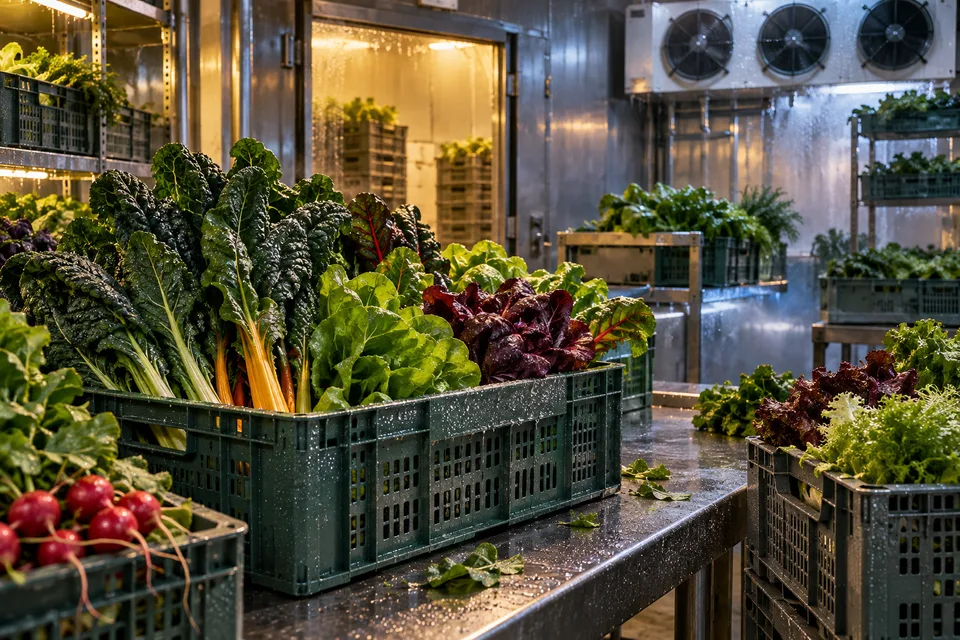
Nor are kilograms a complete diet. Three tonnes of leafy vegetables and three tonnes of grain represent different meals, storage requirements and nutritional contributions. A production photograph generally cannot tell us which calculation was used. It can show a handsome patch of green while leaving the city’s staple foods, oils, livestock feed and seasonal supply outside the frame.
The disappointment arrives only if the roof was sold as a replacement for the surrounding countryside. If it was intended to supply a kitchen, introduce children to growing or give a neighborhood a place to work together, the same harvest can be a success. Urban agriculture needs a more precise ambition, not a more extravagant rendering.
The arithmetic belongs in the proposal
A serious food-production claim should identify the growing area, intended crops, expected seasons and destination of the harvest. Total property area is a poor substitute. A hectare of roof does not automatically provide a hectare of beds, just as the floor area of a restaurant is not the area of its kitchen.
The illustration above also exposes a distribution choice. Three tonnes can reach a large number of people occasionally or a smaller number more regularly. Neither arrangement is inherently better. A project supplying one local institution has a different task from a garden whose members take produce home. “Feeding the community” leaves both the frequency and the recipient unresolved.
We should ask what the harvest replaces. Does the kitchen buy less of the same crop, add a fresh ingredient it otherwise could not afford, or serve extra meals? Those are different benefits. The answer matters especially when a public subsidy is justified by food access: a rooftop restaurant selling premium salads and a neighborhood plot sharing greens should not inherit the same claim merely because both grow inside city limits.
Revenue is another account. High-value herbs can support a business without supplying many dietary calories. That is a legitimate commercial strategy, but it should be described as one. Multiplying a retail price by a hopeful harvest is not yet a business plan; customers, rejects, harvest labor, delivery and the months without a sale all remain to be considered.
This is where a land budget improves the debate. It places a limit on one ambition and allows the others to become specific. The roof may not feed the city. It might provide a dependable ingredient for a nearby kitchen, and that is an outcome worth investigating on its own terms.
A roof is a building before it becomes a field
Putting agriculture on a roof involves a structure that was built for a particular set of loads and uses. Growing media, stored water, people and equipment enter that calculation. So do access, drainage, maintenance and the activities already happening below. The appealing idea of unused space can conceal a very occupied building.
New York City’s Department of Buildings guidance on green roofs calls for a professional engineer or registered architect to assess whether the roof and supporting structure can carry the added load. Its documentation requirements include saturated conditions and access to rooftop equipment. That local guidance illustrates the need for a proper building assessment; it is not a specification for constructing a farm elsewhere.
A productive roof is also an operating arrangement. Someone has to move supplies and harvests between street and growing area. A lift shared with other building users may be a daily constraint. Water has to arrive where it is needed, and the project needs a plan for the building’s own repairs. A roof that requires major work halfway through a planting season is not an abstract planning problem for the grower.
This makes tenure unusually important. The grower invests in a site belonging to another activity, often under another owner. An agreement needs to contemplate access, responsibilities and interruption. A short lease can encourage temporary equipment and discourage patient improvements. A long agreement can support better planning, although it cannot eliminate every change in the building’s future.
None of this makes the idea unworkable. It makes it a relationship between farming and property management. Treating the second half as invisible is one way a beautiful proposal becomes a fragile operation.
The awkward carbon result
Distance is the easiest environmental benefit to imagine. Food grown near its eaters appears to avoid a long journey. Yet transport is only one part of production, and proximity does not erase the materials and inputs required at the growing site.
A 2024 Nature Cities study used citizen-science records from 73 urban-agriculture sites in Europe and the United States. Average emissions per serving were higher than the conventional comparison, although some crops and sites performed better. The authors pointed to infrastructure longevity and circular use of inputs as opportunities for improvement. These were particular urban growing systems, not a verdict on every rooftop, greenhouse or indoor farm.
The result complicates a useful intuition rather than abolishing the activity. A bed, shed or irrigation system has an environmental cost even if the produce travels only a few streets. If the equipment serves several good seasons, that cost is spread across more harvest. If a temporary site closes quickly, the account looks different. “Local” describes location, while the carbon outcome needs a fuller inventory.
That distinction offers a constructive response. Before commissioning a conspicuous new installation, a sponsor could examine whether an established garden needs reliable tenure, repaired equipment or better access to supplies. Improving a durable existing project may be less glamorous than opening another one, but the ability to keep using infrastructure can be important to both its environmental and social value.
There is a corresponding caution about circularity. Calling an input a recovered material does not settle its suitability for food production. A project still needs appropriate assessment, handling and management. The useful goal is a functioning local resource loop, not a collection of green-sounding labels applied to whatever happens to be available.
What a tonne cannot measure
Urban growing can produce relationships as well as crops. People learn from one another, share tools, notice the seasons and participate in the care of a place. Those benefits need neither a self-sufficiency claim nor a competition with an efficient commercial vegetable farm.
New York’s GreenThumb gardeners’ handbook describes community events alongside the work of cultivation. Gardens under Parks jurisdiction are expected to offer public opening hours and free community events. The program therefore treats a garden as a civic place with obligations to people beyond its membership, not simply as a privately allocated crop area.
There is a productive tension here. A garden designed for access and teaching may allocate space and time differently from a business pursuing the largest saleable harvest. A wide path, meeting area or beginner’s bed may reduce output per square metre while improving participation. Judging it only by yield would penalize the very purpose for which it was established.
But invoking community cannot replace the question of who gets in. Opening hours matter to people with fixed work schedules. Membership arrangements matter to newcomers. Paths and facilities matter to people who cannot use a conventional bed or carry equipment. A garden can be welcoming in intention while difficult to join in practice.
The work needs a fair account too. Volunteer time is valuable, not costless. If a project depends on a few people supplying most of the labor, its apparent financial efficiency may rest on their exhaustion. A plan for replacing tools is straightforward compared with a plan for passing on knowledge, resolving disagreements and making participation sustainable across several years.
Public funding can recognize these functions directly. Rather than convert every social benefit into speculative food tonnage, a program can support growing skills, dependable access or neighborhood stewardship and evaluate those outcomes. The harvest remains real, but it does not have to carry the whole explanation for the garden’s existence.
Look beyond the last building
The most photogenic form of urban agriculture can draw attention away from the land around the city. Peri-urban farms may occupy less spectacular sites while supplying substantial quantities of food and participating in the city’s water, transport and labor systems.
FAO’s urban and peri-urban agriculture framework treats these activities together and identifies pressures on land, water and tenure. Its perspective is useful because the city is not a closed food container. Growing within its boundaries and protecting productive land around them are related planning decisions.
A city cannot build a rooftop project at the center and assume that losses at its edges have been compensated. The crop mix, area and output may be entirely different. It also cannot draw a neat line around local food and exclude the suppliers of seed, growing media, machinery or other inputs. A short final journey can still depend on a geographically extended production system.
Regional connections offer another kind of resilience. Relationships with several producers, suitable storage and workable distribution can help a city respond to disruption. A community garden may contribute useful skills and some fresh food to that system. Expecting it to absorb a large interruption in staple supply sets it a task it was never equipped to perform.
The more practical ambition is complementarity. Support spaces where urban residents can grow; maintain routes through which regional producers can reach customers; protect the land and services those producers require. These measures serve different parts of the same food system rather than competing to provide a single heroic solution.
A smaller promise, a stronger project
The best proposal might begin with an ordinary sentence: this site will grow particular crops for particular people, and provide this additional public use. It would put a plausible production estimate beside the resources needed to achieve it. It would name who manages the building relationship, where the produce goes and how the project continues after the opening event.
Its account would allow several forms of success. A commercial grower should demonstrate a workable business. A teaching garden should demonstrate learning and participation. A food-access project should show that food reaches its intended recipients in a useful way. Projects can combine these purposes, but the combination needs people and resources rather than a promise that each benefit arrives automatically with the first seedling.
Our imaginary roof still produces three tonnes. That quantity has not changed through the argument. What changes is the burden placed on it. It no longer has to prove that an entire metropolis can retreat from its countryside. It has to justify a particular use of a particular place, with an honest harvest and a credible relationship to the people below.
Sources & context
This article draws on the sources linked in the text. Analysis and illustrative scenarios are identified separately from reported findings.
- Department of Buildings guidance on green roofs
- 2024 Nature Cities study
- GreenThumb gardeners' handbook
- urban and peri-urban agriculture framework