A honeybee makes pollination easy to picture. A cacao flower asks us to look more closely, toward the much smaller insects associated with its pollination. Across food crops, the useful visitors, flowering periods and surrounding habitats differ. The familiar hive is one part of that landscape. Following the flower into the harvest brings the other pollinators into view, along with the limits of a food-security story told through a single charismatic insect.
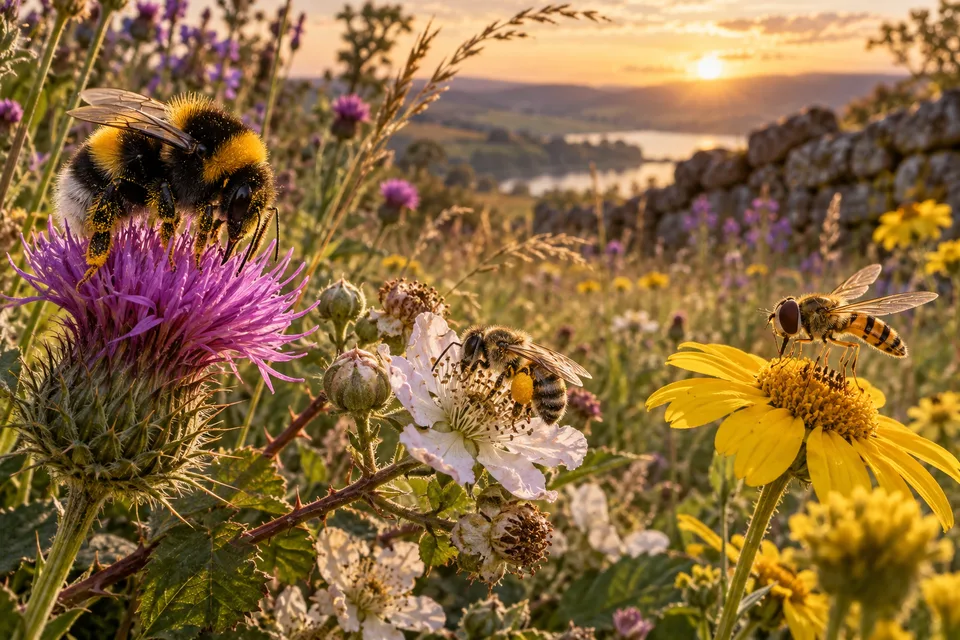
Wild bees, flies, beetles, butterflies and other animals visit flowers too. Their contribution depends on the plant, place, season and interaction. Some crops benefit from several kinds of visitors; others have more specific relationships. Counting managed hives describes an agricultural input, not the complete condition of pollination in the surrounding landscape.
FAO’s pollination program places wild and managed pollinators within the same agricultural conversation and emphasizes habitat and forage for both. This wider view leads to a different practical question. Instead of asking only how many bees can be brought to the crop, ask what enables useful pollination to continue before, during and after that crop flowers.
Start with the flower, rather than the logo
A flower visitor is not automatically an equally effective pollinator. The interaction has to move suitable pollen in a way that contributes to the plant’s reproduction. The usefulness of a visit therefore depends on more than the number of insects seen near a field.
This is why crop-specific evidence matters. The relationship between an insect and one flower cannot simply be copied onto another plant. A busy-looking scene can contain different visitors doing different things, while a less conspicuous insect may make an important contribution that a casual observer misses.
Cacao illustrates the danger of assuming the familiar honeybee must be the central actor. Kew’s account of research into cacao-flower scent discusses the role of midges and the investigation of the signals attracting them. The tiny flower and its visitors belong to the chocolate supply chain even though neither resembles the standard picture used to advertise bee conservation.
The appropriate response is not to replace one mascot with another. It is to retain the diversity of relationships. A pollination service is produced by living interactions, and the agricultural question needs to identify which interactions matter for the crop and the conditions being studied.
That can make management less simple, but more accurate. A farmer may use managed colonies and still benefit from wild visitors. A conservation project may support species that are rarely seen on the main crop. Their roles should be investigated rather than assigned according to which animal is easiest to photograph.
Three percentages that should not trade places
The 2016 IPBES pollination assessment distinguishes the number of crop types benefiting from animal pollination from the volume of production dependent on it. More than three quarters of leading food-crop types benefit; around 35% of production volume comes from crops dependent at least partly on animal pollination. Its estimate of the production directly attributable to animal pollination is smaller, at 5–8%.
These statements do not mean that three quarters of all food would vanish without bees. They concern different denominators and degrees of dependence, and the assessment is about animal pollinators rather than one species. Turning them into a single dramatic percentage misrepresents why pollination matters.
Production volume is also not the only relevant value. A crop can contribute relatively little global tonnage while being important to a particular diet or farming income. Conversely, a large-volume staple with little animal-pollination dependence can dominate an aggregate without describing the diversity of foods people value.
The right denominator depends on the question. A global production assessment, a household’s diet and a farm’s livelihood are different accounts. Each can show a significant role for pollination without borrowing the largest number from another account.
The honeybee does not cancel the wild insects
A 2013 multi-crop study in Science found positive associations between wild-insect visitation and fruit set regardless of honeybee abundance. The authors argued for integrated management of honeybees and diverse wild assemblages. It is evidence of complementary contributions in the studied systems, not a universal formula for the correct hive density on every farm.
The distinction matters commercially. Managed colonies can be moved and supplied as a service. Wild pollinators depend on conditions beyond the crop’s immediate purchase order. Treating the first as a complete substitute for the second can make the wider landscape seem expendable even when it supports valuable pollination.
It also matters for conservation. Increasing the abundance of one managed species is not equivalent to increasing wild-pollinator diversity. A project can install hives and produce honey while leaving questions about nesting habitat, seasonal food or the condition of other insects unanswered. Those can be worthwhile activities, but their claims need to match their outcomes.
An August 2026 Communications Biology study analyzed European plant–pollinator interactions along a gradient of honeybee dominance. It found associated changes in resource overlap and wild-pollinator diets, while explicitly leaving consequences for population dynamics and long-term ecosystem functioning open. The result does not establish that every hive causes a decline, or that removing honeybees is a universal conservation prescription.
It does establish a reason to avoid an automatic “more is better” response. A local decision should consider the relevant community, resources and purpose. The useful target is a functioning ecological and agricultural relationship, not the largest possible count of a familiar insect.
A landscape has a calendar
A crop may offer a concentrated flowering period. Pollinator populations need suitable conditions beyond that interval. Food, nesting or other life-cycle requirements can be located in different parts of the landscape and become important at different times.
This makes a seasonal planting photograph an incomplete conservation record. A flowering strip can be useful, but its contribution depends on what is planted, when it flowers, how it is managed and which species can use it. The number of blooms on an inspection day cannot describe the whole year.
The same applies to habitat area. A hectare is a spatial measure, not a direct measure of every ecological function. Connectivity, condition and the needs of the local species influence what it provides. A conservation plan should be specific enough to explain the intended role rather than count all green space as interchangeable.
Farm management interacts with these conditions. Pollinators cross property boundaries, and a local improvement can depend on what happens nearby. That creates a collective problem: the participant doing the work may not capture every benefit, while the crop benefiting may rely on habitat someone else maintains.
Coordination and appropriate support can help address that mismatch. The arrangement should recognize the farmer’s costs and constraints rather than assume that a public ecological benefit can always be supplied without compensation or changes elsewhere in the system. A field is part of a business as well as a habitat.
Follow the pollinator into a household
A Nature study published in May 2026 connects the ecological network to individual diets and farming income in smallholder communities in Nepal. The researchers recorded crop yields, diets, income and insect interactions, then estimated pollinators’ contribution to the participating families. Their estimate attributed 44% of the participating families’ farming income and more than 20% of their vitamin A, folate and vitamin E intake to insect pollination. Native honeybees, bumblebees and hoverflies were important in those nutrient pathways. These are estimates for the studied communities, not percentages of every person’s diet worldwide; farming income is also a narrower denominator than total household income.
The study’s significance is the route it makes visible. A wild plant supports an insect; that insect contributes to a crop; the crop becomes food or income for a family. The chain turns an abstract ecosystem service into a relationship that can be investigated, including which parts of it support people with fewer alternatives.
It also prevents a purely global tonnage measure from doing too much work. A loss affecting a nutritionally or economically important local crop can be consequential even when it barely moves a world production total. Local vulnerability depends on the foods, incomes and substitution options available to the household.
An ecological intervention should therefore be assessed through both the environment and the intended human outcome. A change in visitors to flowers is informative; a change in crop production is another result; an improvement in a household’s diet or income requires further evidence. Connecting them is valuable research, not an automatic conversion from insect counts to human benefit.
Not every species needs to earn its place in a crop budget
The economic argument for pollinators is powerful, but it has a limit. If conservation protects only the species that can be assigned a large current crop value, it will leave much biodiversity outside its account.
A 2015 Nature Communications analysis makes this distinction explicit, arguing that delivery of crop-pollination services is insufficient as the entire justification for wild-pollinator conservation. Common crop visitors can contribute substantial economic value without representing all the species that need protection.
This is not a reason to stop calculating agricultural benefits. It is a reason to keep the benefit calculation in its proper role. It can explain one important relationship between people and ecosystems. It cannot settle every question about which species or habitats deserve to continue existing.
For public programs, the distinction helps separate objectives. A project intended to improve a crop’s pollination should measure the relevant service. A project intended to protect a threatened species needs evidence about that species and habitat. One project may support both, but the overlap should be demonstrated rather than presumed.
Look at what the observer counted
A count needs an observation method. Ten insects seen during a brief visit cannot be compared directly with ten recorded over a longer survey, under different weather or across a larger area. A change in the number observed may reflect effort or conditions as well as the animals present. Repeated, appropriate sampling helps distinguish those possibilities.
The outcome measure needs the same care. More visits do not by themselves prove that pollination was the factor limiting yield, and a yield change can have causes beyond pollination. A useful study is designed to investigate that link rather than infer it from two favorable lines on a chart.
This is particularly important when a business publicizes a conservation intervention. Installing habitat, observing insects and demonstrating a sustained ecological result are distinct stages. Reporting the stage reached is more informative than allowing a photograph of new planting to stand for all three. The purpose of measurement is to improve the intervention, including learning when its first design needs to change.
A better picture than the hive alone
A credible pollination account would identify the crop, the important visitors, the seasonal resources and the outcome being sought. It would distinguish managed-colony numbers from wild-population condition and avoid treating one brief survey as a permanent verdict. Where evidence is incomplete, it would say what still needs to be learned.
That is a more demanding story than a photograph of a hive beside a field. It is also a more useful one for farmers, conservationists and people who want to understand the food on their table. It leaves room for managed beekeeping as an important activity while preserving the relationships that its most familiar symbol can obscure.
The honeybee can stay on the cover. The rest of the pollination network needs to remain in the article—and in the landscape that makes the crop possible.
Sources & context
This article draws on the sources linked in the text. Analysis and illustrative scenarios are identified separately from reported findings.
- pollination program
- account of research into cacao-flower scent
- 2016 IPBES pollination assessment
- 2013 multi-crop study in Science
- August 2026 Communications Biology study
- Nature study published in May 2026
- 2015 Nature Communications analysis