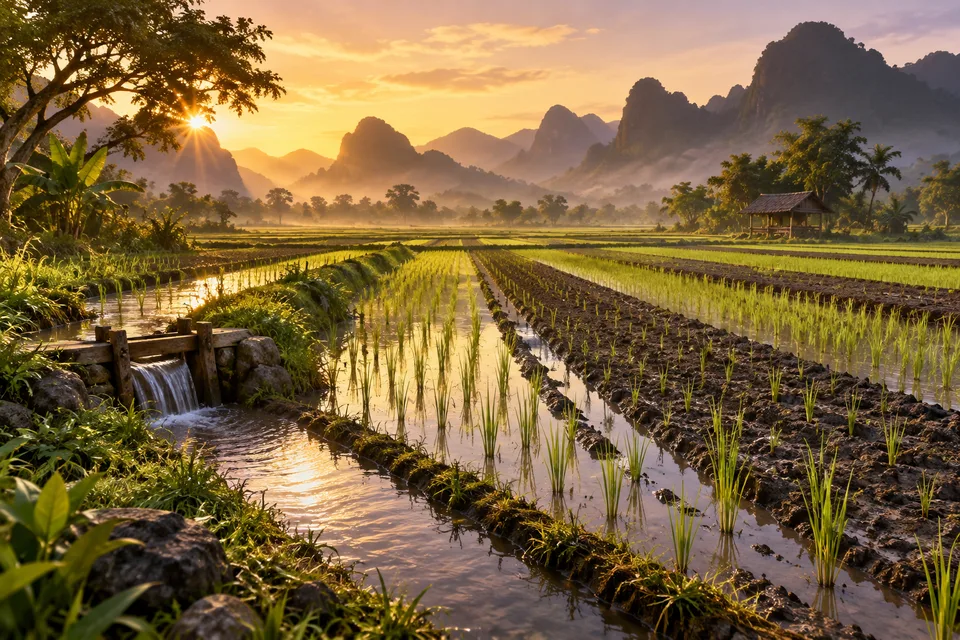
A dry interval in a rice field can look like a simple climate intervention. Remove the persistent layer of water, interrupt the conditions supporting methane production, and allow the crop to continue. The idea has substantial research behind it. The apparent simplicity is misleading only if the irrigation system, soil and farmer’s circumstances are left out.
Alternate wetting and drying, usually shortened to AWD, is a managed water regime for suitable irrigated rice systems. It alternates flooded and nonflooded conditions while maintaining the water needed by the crop. It is not an instruction to expose every rice field to an arbitrary drought.
IRRI’s overview of AWD describes both water-saving and methane-mitigation potential, along with monitoring of the field’s water level. Its perforated monitoring tube lets the farmer see water below the soil surface after standing water has disappeared. The overview describes a usual re-irrigation trigger around 15 centimetres below the surface; that is a water-level observation, not an instruction to leave every crop dry for fifteen days. The appropriate regime still depends on crop stage and local agronomy. The farmer must be able to recognize the chosen trigger and obtain water when it is reached. A field’s ability to dry is only half of the arrangement. The other half is its ability to receive water again.
That second half turns a biological opportunity into an infrastructure and governance question. A farmer can follow an agronomic recommendation and still depend on neighbors, canal operators, a pump, an electricity supply or a delivery schedule. The climate bargain succeeds when those relationships support the field rather than expecting the field to absorb their failures.
The first bargain: less methane, with the crop still in view
Flooded soils support conditions in which microbes can produce methane from organic material. Managed periods without standing water can interrupt those conditions. This makes water management an important route for reducing emissions associated with rice production.
There is another gas to consider. Changes in water conditions and nitrogen management can affect nitrous oxide, so a favorable methane result is not the complete greenhouse-gas account. A study needs to examine the relevant gases and the production outcome together, using a stated comparison.
A March 2026 global meta-analysis synthesized 5,322 field experiments from 504 studies published between 1991 and 2024. It found that AWD could reduce combined emissions while maintaining or improving yield in the comparisons analyzed, with methane reductions outweighing increased nitrous oxide. The authors also emphasized variation by environmental context and interactions among farming practices. The synthesis is not a guarantee of the same result in every field.
That distinction is important to a farmer being asked to change a familiar regime. Maintaining production is part of the proposition, not an incidental benefit to be checked later. A reduction that comes with unacceptable yield risk presents a different bargain from a reduction achieved with dependable crop performance.
Research should therefore retain both the area-based result and the production-based result where relevant. Emissions per hectare answer one question; emissions per quantity of grain answer another. A change in yield can alter the second even if the first improves. Choosing whichever number looks best hides the trade-off rather than resolving it.
An illustrative calculation shows the issue without pretending to be a field trial. Imagine a hectare producing five tonnes with an emissions total of ten arbitrary climate units. The intensity is two units per tonne. If emissions fall to eight and output remains five, both accounts improve. If output instead falls to three, the area total is lower but intensity rises to about 2.67. Those invented values simply explain why crop output belongs in the assessment.
The proper response to variation is not to abandon water management. It is to identify the suitable places, regimes and support. A good average can justify further investigation without eliminating the need to understand where the average will not translate well.
The second bargain: a drying field needs a reliable canal
The farmer who decides not to irrigate today may need confidence that irrigation will be possible later. A rigid delivery schedule or an uncertain pump changes that decision. Keeping water on the field can become a response to supply risk, even when using less would be desirable under more reliable conditions.
IRRI’s MapAWD suitability tool considers climate risks and soil information within a spatial water-balance approach. Rainfall, cropping season and percolation enter its assessment. The tool illustrates why a management regime should be evaluated in relation to place and season rather than attached to rice as a universal label.
The landscape also matters. Water moving through a shared system reaches fields under different conditions. Elevation and position relative to a source can influence what a farmer receives and how much control is available. A recommendation that fits one part of an irrigation area may be more difficult in another.
A February 2026 IRRI account of research in Philippine gravity-fed systems identifies soil, elevation, rigid water governance and tenancy among adoption barriers. It presents the work as a problem of adapting the practice to a social and physical system. Providing a field-monitoring tube is useful, but it does not independently redesign canal operations or land agreements.
This helps explain why a low-cost technique can still be hard to adopt. Its equipment may be inexpensive while the coordination required is significant. Several farmers and an operator may have to adjust expectations together. If one participant’s decision affects another’s supply, an individual training session cannot settle the whole arrangement.
The costs can appear outside the budget of the climate project. A farmer spends time observing water conditions; an operator changes a schedule; an institution resolves complaints. These are real requirements even if they do not resemble a major construction investment. A credible plan identifies who undertakes the work and how it continues after the pilot team leaves.
The timing of the crop brings another limit. IRRI’s guidance on safe AWD protects sensitive stages, including establishment and flowering. A working program needs suitable local agronomic advice, not merely a target for the largest number of dry days. The dry interval is a means to an intended outcome, not an achievement to maximize regardless of the crop.
Less irrigation delivered to a field also needs a clearly named accounting scale. A project reporting delivery volumes should retain that description rather than quietly converting it into a claim about every use of water across a basin. The practical question is what changed at the measured location and what became possible elsewhere as a result. A saving that reduces pumping can be valuable on that basis; a claim about additional water available to other users needs evidence about the shared system.
The third bargain: the farmer needs a reason to take the risk
Climate benefits extend beyond the field. The costs and perceived risks of changing management may remain with the person growing the rice. If a program ignores that difference, its technical success can coexist with limited participation.
Water pricing offers a concrete example. IRRI’s account of trials in Bangladesh, presented in 2018 and published in 2019, reported different results under volumetric and fixed seasonal charges. The monitoring technology saved water and improved profits where farmers paid by volume, but showed no measurable effect where they paid a fixed seasonal charge. These were particular trials, not a description of every Bangladeshi irrigation arrangement today.
The mechanism is easy to understand. When using less reduces a bill, conservation has a visible private benefit. When the bill remains the same, the farmer may receive little immediate financial reward from the same reduction. The public benefit has not necessarily disappeared; the reason for the individual to pursue it has changed.
Tenancy complicates the account further. A tenant may be reluctant to try a practice perceived as threatening a harvest or a relationship with the landowner. Long-term environmental gains do not automatically compensate for a near-term concern about keeping access to the field. The program needs to understand who has the authority to change management and who carries a disappointing result.
Payments for emissions reductions can be part of the response, but they bring their own operating needs. The project must define the comparison, demonstrate suitable evidence and administer payments. The farmer needs to understand the obligations and timing, rather than hear only a theoretical value assigned to an avoided tonne.
The monitoring effort should fit the proposed benefit. If a program asks farmers to supply substantial records or accept restrictions, it needs to account for that burden. A system advertised as simple at field level can become complicated when converted into a commercial carbon claim. Those complications should be planned for rather than handed to participants after enrollment.
Risk-sharing is just as important as the size of an incentive. A farmer considering a changed regime needs access to advice and a clear response when conditions become unsuitable. The program should not interpret a return to flooding under a legitimate crop constraint as disloyalty to its climate target. Adaptation is part of responsible management.
The fourth bargain: evidence should survive contact with ordinary farms
Controlled experiments are valuable for understanding mechanisms. A shared irrigation area adds variability in management, access and implementation. Demonstrations and landscape-level studies help examine whether the practice works under those conditions, including for participants with less convenient positions in the system.
An August 2026 IRRI report on a Philippine study describes water-use reductions of 8–13% without an adverse yield effect in the service area studied. It also discusses differences related to location within the irrigation system. The finding is evidence for that setting and intervention, not a promise that each future installation delivers the same percentage.
Another August 2026 IRRI account from Andhra Pradesh describes field demonstrations combining AWD with other farming practices. It explicitly notes that the approach is unsuitable in some regions and seasons where timely, assured irrigation is unavailable. That qualification belongs near the proposal’s headline, not buried after the benefits.
These accounts are encouraging because they investigate the conditions for implementation. They also show why a number from one trial should travel with its setting, season and comparison. The climate story becomes more useful when it names where a result was observed and what support helped produce it.
There are other management decisions in the field. Nitrogen, residues, crop establishment and the preceding season can affect the emissions and production account. Water management should be assessed alongside them without assuming each intervention’s separately estimated benefit can simply be added. Practices can interact, and a combined system is its own subject for evaluation.
Longer-term adoption requires observing more than initial enrollment. Do farmers continue the regime when the project team is less present? Can operators maintain a workable schedule? Are the records credible across different seasons? A successful launch establishes participation at a moment; durable operation requires a continuing arrangement.
The water-level tube is still a useful symbol of that arrangement. It makes a hidden condition visible and helps a farmer decide when water is needed. But its reading becomes actionable only when the surrounding system can respond. The instrument supplies information; infrastructure and institutions supply the possibility of acting on it.
For rice, the climate bargain is consequently both modest and demanding. Change a suitable field’s water regime, support the crop, evaluate the relevant gases and reward the work fairly. The opportunity is substantial precisely because this is real agriculture, with real livelihoods and food at stake. The way to realize it is to keep those realities in the design.
Sources & context
This article draws on the sources linked in the text. Analysis and illustrative scenarios are identified separately from reported findings.
- overview of AWD
- March 2026 global meta-analysis
- MapAWD suitability tool
- February 2026 IRRI account of research in Philippine gravity-fed systems
- guidance on safe AWD
- account of trials in Bangladesh
- August 2026 IRRI report on a Philippine study
- August 2026 IRRI account from Andhra Pradesh