Start at the supermarket, where the story appears easiest. A shopper scans a square on a packet and sees a boat, a place name and a confident account of the fish inside. The page loads with no visible gap in the story. The fish may have passed through several less tidy handoffs before the information reached that screen.
Traceability is that longer task. A QR code can direct a person to a record, but it does not create the record’s missing links or verify the claims within it. The attractive consumer page is an output of the system. Its credibility depends on work that mostly happens before the fish becomes a retail packet.
FAO’s guidance on end-to-end fisheries and aquaculture traceability emphasizes critical tracking events and key data elements. Put plainly, the system needs to know which events matter and what information must accompany them. Standardization and participation across the chain are part of the task, rather than features added after a branded website is finished.
Follow an imaginary lot through that chain and the difficulty becomes clearer. No company or shipment below is real. The example is a way to examine how information can be retained or lost when a food changes form and ownership.
At the landing: give the lot a useful identity
Our fish arrive with a harvest record. The receiver creates a lot identified as H17 and records the relevant information about origin, species, quantity and the transaction. H17 is useful only if its meaning remains clear to the businesses that later encounter it.
A local identifier is not automatically a globally unique one. Another supplier might also call a lot H17. If a processor receives both, an unexplained code can become ambiguous. The identity therefore needs sufficient context to distinguish the object being tracked, and the parties need an agreed way to exchange it.
GS1’s Global Traceability Standard distinguishes product, batch and individually serialized identification. These levels serve different purposes. Knowing a product type is less specific than knowing its batch, while tracing each individual object can require a more detailed system. The appropriate level depends on the task and the operations involved.
This is already a reason to question a highly personalized retail story. The production system may retain a group of possible sources rather than the identity of one fish. A consumer page should reflect the level of specificity actually supported. An evocative boat photograph does not justify selecting that boat as the unique origin if the records only identify a broader pool.
The first record also needs credibility. A database can preserve a false statement very effectively. Traceability helps retain and connect information; checking whether harvest information is accurate may require additional documents, verification or investigation. The two tasks support each other without being the same thing.
At the processor: the fish changes and the identity must follow
H17 enters a processing run. Whole fish become portions. Some material leaves in other forms, and the output receives another identifier, P42. The important record is the relationship between what entered the process and what came out.
GS1’s seafood traceability guideline sets out input and output identifiers and quantities for processing events. The underlying idea is accessible even without reading a technical schema: the new product must remain connected to the materials from which it was made. Keeping a label on the incoming box is insufficient once its contents have been transformed.
Suppose the processor combines H17 and another incoming lot in the same run. P42 may now connect to both. A record of that combination can preserve an honest history, although it no longer establishes a unique incoming lot for every individual portion. The system should not silently become more precise when its story reaches the shopper.
Splitting presents the reverse problem. P42 might leave the facility in several shipments. Each recipient needs enough information to connect the received product to the relevant process record. If the relationship stops at the processor’s internal spreadsheet, the next company has a label but no accessible history behind it.
Quantities help examine whether the records make sense. They must be interpreted in relation to the process, because a whole-fish input and a portioned output are not the same physical form. For an invented 100-kilogram whole-fish intake, 45 kilograms of portions and 50 kilograms of separately recorded heads, frames and other material leave five kilograms still to explain. Those assumed quantities are not a species-specific yield standard. They show why accounting for coproducts is different from insisting that portion weight equal whole-fish weight—and why an unexplained remainder is a question for investigation.
This is the awkward middle of the seafood story. It involves mundane production runs, rejected labels, units and reconciliations. Yet the attractive page at the end depends on exactly this sort of work. The moment when the fish becomes less recognizable is also the moment when information has to become more carefully organized.
At the handoff: two working databases can still fail to talk
The processor sends P42 to a distributor. Each company may possess a sophisticated system and still disagree about field names, formats or meanings. A date can refer to harvest, processing or shipment. A location can refer to a vessel, landing place or factory. The presence of a populated field does not ensure the receiver interprets it correctly.
The Global Dialogue on Seafood Traceability standard addresses the data elements and technical formats used for exchange. Its development includes work on communication protocols because a shared vocabulary alone did not settle every interoperability problem. The standard is an industry framework, not evidence that every company claiming traceability has implemented it completely.
GS1’s EPCIS framework similarly supports exchange of event information through a common language. The point is not that shoppers should learn a messaging standard. It is that businesses need a way to retain meaning when information crosses organizational boundaries.
The receiver also needs a response to incomplete information. Does it accept the shipment provisionally, request a correction, restrict a claim or reject the product? A software system can flag a missing value, but someone has to decide what the flag means operationally. If staff routinely bypass it to keep deliveries moving, the formal data model and the actual chain have separated.
Corrections need a history too. An error may be discovered after several shipments have left. The useful system can identify the affected records, update the information appropriately and communicate the change to relevant parties. A consumer page that continues presenting an old story after the underlying record has changed is not keeping up with its own supply chain.
At the border: several programs ask different questions
Regulatory traceability and consumer storytelling overlap, but their objectives and coverage differ. An importer may have to retain information supporting lawful harvest; another rule may concern rapid investigation of a food-safety incident. A retail sustainability narrative asks further questions that neither objective automatically resolves.
NOAA’s Seafood Import Monitoring Program is a risk-based US program covering specified seafood. It requires harvest-to-entry information and supports investigation of whether products were lawfully harvested or produced. It is not a general certificate that every seafood item has an individually identified, sustainable and socially responsible origin.
The program’s January 2024 compliance guide also illustrates the distinction between a shipment’s records and the identity of one portion: it does not require linking each particular fish or portion in the shipment to a single harvest event. A consumer claim should not infer greater precision than the chain provides.
In the European Union, the digital CATCH certification system became compulsory in January 2026 for importers handling products subject to the catch-certificate requirements. The purpose includes tackling illegal, unreported and unregulated fishing. The broader fisheries-control reforms have phased application dates, so a reference to “the new rules” should not imply every provision began together.
The FDA’s Food Traceability Rule page describes another timing distinction. It records a proposed compliance extension and a Congressional direction not to enforce the rule before July 20, 2028. This is not the same as saying traceability has ceased to matter until that date, or that all seafood falls under identical requirements.
The useful lesson is to identify the program and its question. A claim about legal harvest, a claim about food-safety records and a claim about environmental performance need the relevant evidence. Combining their names on one landing page does not combine them into a single universal guarantee.
At the checkout: what should the shopper actually learn?
Our packet contains product from P42. An honest consumer page might identify the species, production method and origin information supported by the records. It might explain that the batch can connect to more than one harvest lot. It would not need to become an intimidating technical report, but it should retain the distinctions that affect its claims.
The strongest page would also distinguish a recorded statement from a verified one. If a certification or assessment is invoked, the scope matters: which product, facility or part of the chain does it cover? A general company commitment is not necessarily a finding about the packet being scanned.
Claims about labor and environmental outcomes deserve their own evidence. Knowing the route of a fish can help identify where to investigate, but the route alone does not establish working conditions or the state of a stock. Traceability is infrastructure for accountability, not the entire accountability result.
Some information can reasonably remain restricted because it concerns commercial arrangements or sensitive locations. That does not excuse an unsupported public claim. The business should be able to explain the basis and specificity of what it tells the shopper, while authorized investigators have access to the detail needed for their task.
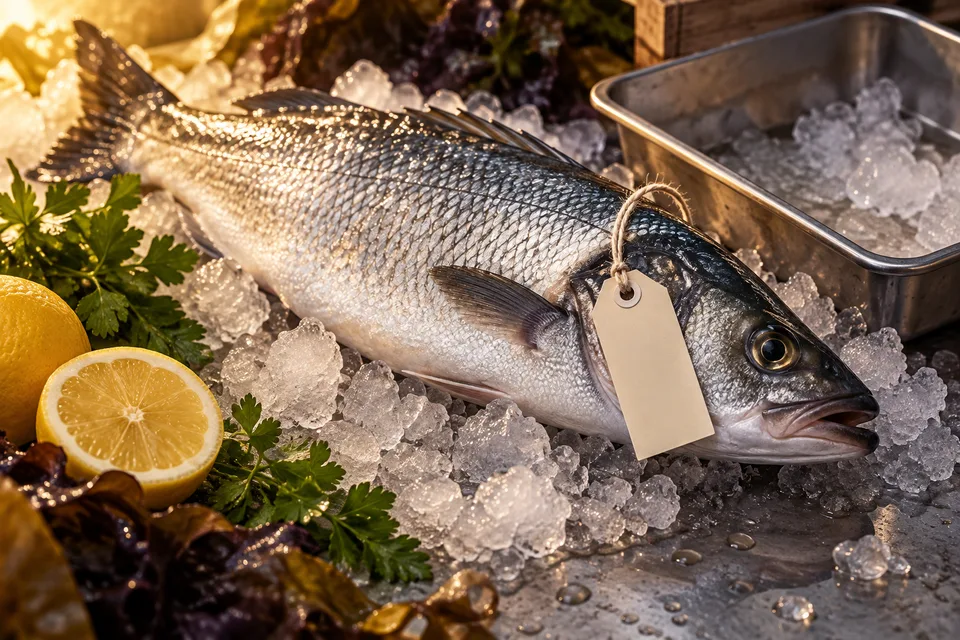
There is an editorial choice in the imagery as well. A real photograph from one supplier’s boat may be attractive while irrelevant to the scanned lot. A generic image can be used as illustration, provided it is not presented as evidence of a unique origin. The story should become clearer as it becomes easier to read, not more certain than its records.
Test the chain in both directions
One practical demonstration is to start with a retail batch and work backward. Can the responsible businesses recover the relevant processing, shipment and origin relationships? Where does information stop, and what happens when an identifier is unclear? The exercise tests more than whether the consumer link opens.
The reverse journey is useful too. Start with an incoming lot and ask which outputs and recipients can be identified. If a problem arises upstream, the system needs to help locate what left downstream. A chain that tells an origin story but cannot investigate affected product has solved only part of its task.
These exercises should include difficult cases: combined lots, splits, corrected records and interruptions in data exchange. Testing only a carefully curated demonstration shipment can leave ordinary operational failures undiscovered. The desired result is a system that handles the actual business, including its untidy days.
Return to the shopper and the square on the packet. The code is still useful. It gives the person a convenient way into information that would otherwise remain inaccessible. But its value comes from the chain behind it: credible records, preserved relationships and businesses willing to act when those relationships fail.
The fish does not become traceable when the camera recognizes a QR code. That is when someone gets to ask how well the tracing has been done.
Sources & context
This article draws on the sources linked in the text. Analysis and illustrative scenarios are identified separately from reported findings.
- guidance on end-to-end fisheries and aquaculture traceability
- Global Traceability Standard
- seafood traceability guideline
- Global Dialogue on Seafood Traceability standard
- EPCIS framework
- Seafood Import Monitoring Program
- January 2024 compliance guide
- digital CATCH certification system became compulsory in January 2026
- fisheries-control reforms have phased application dates
- Food Traceability Rule page